
Healthcare organizations often have more data than usable insight. Strategic Healthcare Partners helps hospitals, physician practices, provider networks, independent physician associations, and clinically integrated networks transform EMR/EHR, claims, financial, and operational data into customized reporting.
Our analysts help clients monitor performance, identify revenue and operational opportunities, evaluate provider productivity, and prepare for changing reimbursement models. We also help leadership teams interpret findings and determine practical next steps.
Turn Data Into Practical Improvement
SHP Performance Analytics combines reporting with healthcare-focused analysis. The goal is not simply to deliver more reports. It is to help leaders understand performance, identify the likely causes of financial and operational variation, and prioritize improvements that support patient access, clinician performance, and financial sustainability.
Improve financial visibility
Monitor collections, accounts receivable, reimbursement, underpayments, and revenue trends.
Identify operational bottlenecks
Evaluate scheduling, access, no-shows, cancellations, wait times, and other performance indicators.
Evaluate provider productivity
Compare charges, collections, encounters, work relative value units, and related productivity measures.
Support network strategy
Use aggregated reporting and benchmarking to inform value-based care and provider-network decisions.
Financial Reporting
Build a clearer view of revenue-cycle and reimbursement performance with reporting designed around the questions healthcare leaders need to answer.
- Collections performance: Monitor collection activity and evaluate performance over time by location, provider, payer, service line, or other available dimensions.
- Accounts receivable analysis: Track A/R trends, aging, percentage over 90 days, payer performance, and detailed account-level information. Confirm the definition and methodology used for any “matched A/R” measure before publication.
- Underpayment and reimbursement analysis: Compare expected and actual reimbursement, identify potential payer variance, and prioritize follow-up opportunities.
- Revenue trend reporting: Review month-end performance, moving averages, year-to-date comparisons, and year-over-year changes.
- Chargemaster and pro forma analysis: Evaluate charge structure and model what-if scenarios to understand potential effects on revenue and reimbursement.
Operational Reporting
Connect operational measures with financial and patient-access outcomes to identify where processes are working and where improvement may be needed.
- Scheduling and access analytics: Monitor schedule utilization, appointment availability, lead time, wait time, no-show rates, cancellations, and bumped appointments.
- Practice and location performance: Compare results across practices, locations, departments, service lines, or other organizational units using consistent definitions.
- Trend and benchmark reporting: Compare current results with six-month moving averages, prior year-to-date performance, the same month in the prior year, and approved internal or external benchmarks.
- Customized operational reporting: Develop reports around an organization’s priority questions, available data, and decision-making needs.
Provider Productivity Analytics
Evaluate provider performance using measures appropriate to specialty, compensation methodology, and organizational goals. Reporting may include encounters, charges, collections, work relative value units (wRVUs), procedure or evaluation-and-management coding patterns, payer mix, and other agreed measures.
SHP analysts help leadership teams interpret results in context rather than relying on a single productivity measure. Any external benchmark source, comparison cohort, and time period should be identified when benchmark data are presented.
Network and Value-Based Care Analytics
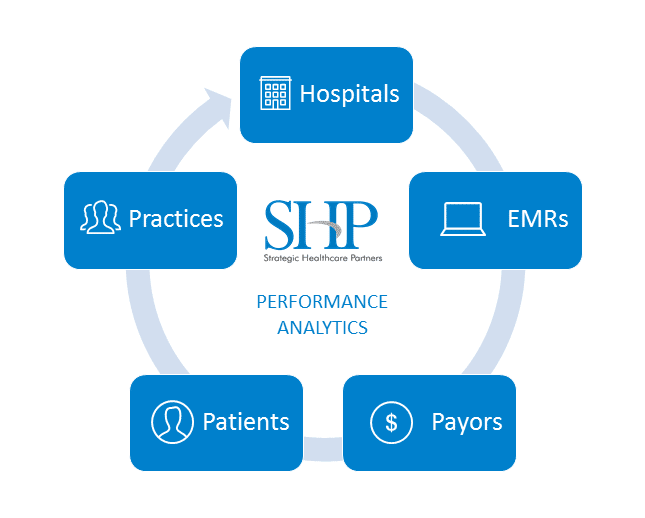
Provider networks need consistent, connected information to evaluate performance across participating organizations. SHP supports detailed reporting and benchmarking for independent physician associations, clinically integrated networks, hospitals, and community-based providers.
Depending on available data and the engagement scope, reporting may include patient attribution, payer mix, utilization, access, quality, population health, reimbursement, and network performance. SHP can help leadership teams evaluate readiness for value-based care and identify data-integration priorities.
How the Analytics Process Works
Align reporting with leadership priorities, business goals, and the decisions the organization needs to make.
Identify available systems, data sources, time periods, measures, filters, and reporting limitations.
Develop reports, confirm calculations and definitions, and establish an appropriate reporting cadence.
Review trends, variation, and likely drivers with SHP analysts.
Translate findings into practical financial, operational, or network improvement opportunities.
Why Healthcare Organizations Partner With SHP
- Healthcare-specific perspective across financial, operational, managed care, and provider-network performance
- Customized reporting aligned with the organization’s questions and available data
- Analyst support to interpret findings and identify practical next steps
- Ability to connect analytics with related SHP services, including managed care contracting, revenue cycle, provider enrollment, and network development
Frequently Asked Questions
SHP supports hospitals, physician practices, provider networks, independent physician associations, clinically integrated networks, and community-based healthcare organizations. The final wording should reflect the current client base.
SHP can evaluate available clinical, claims, financial, and operational data sources and determine an appropriate reporting approach. List specific supported systems only after operational confirmation..
Reporting can be aligned with the organization’s priority questions, available data, leadership needs, and agreed engagement scope.
Reporting frequency should be described using the actual service model, such as monthly, quarterly, on demand, or a combination.
Describe approved controls and contractual safeguards accurately. Avoid an unsupported blanket claim. If “HIPAA-compliant” is used, legal, security, and operational owners should validate the statement.
SHP analysts review findings with client leaders and help identify practical next steps. Identify any implementation support that is included or separately scoped.